
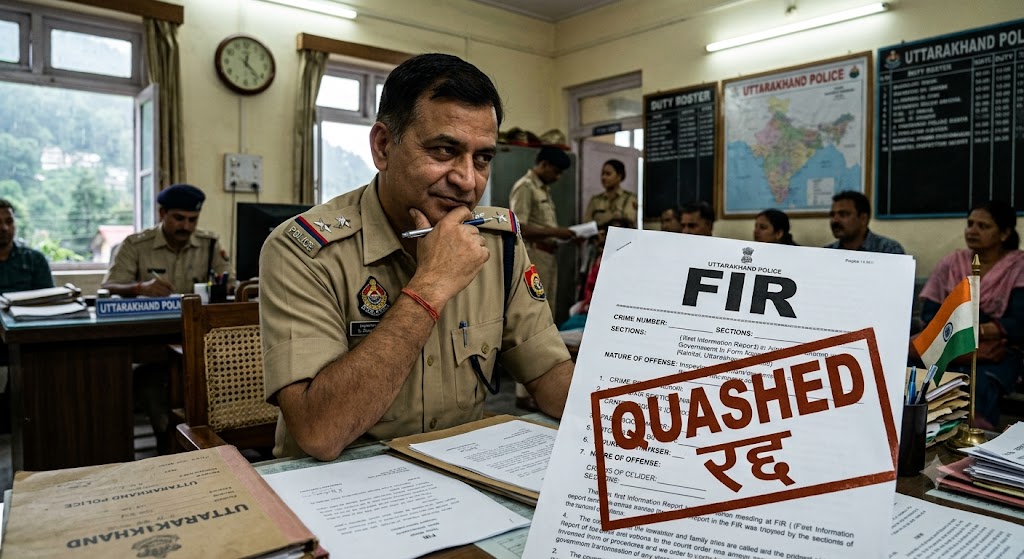
Can an FIR Be Quashed in Uttarakhand? Know If Your Situation Qualifies
If an FIR has been filed against you, the fear is immediate — will this control the next few years of your life? Will there be a trial, arrest, humiliation in front of family and neighbours? In many cases, the answer is no. As a criminal lawyer practicing before the Uttarakhand High Court at Nainital, this is one of the questions we’re asked most often, and FIR quashing is a real, established remedy — the High Court can step in and quash an FIR entirely, before it ever reaches trial — but only in certain kinds of situations. Here’s how to know if yours is one of them.
“We had a business deal that went sour, and now there’s a police complaint.”
This happens more often than people realize. A loan isn’t repaid on time, a business partnership breaks down, a payment gets delayed — and instead of pursuing it as the civil, contractual dispute it actually is, one side files a criminal complaint alleging cheating or breach of trust, hoping the threat of arrest will force a quick settlement. Courts have consistently recognized this pattern for what it is — a civil dispute wearing a criminal disguise — and have quashed FIRs where the underlying facts show nothing more than a business disagreement. If money, a contract, or a business relationship is at the heart of the complaint against you, this is one of the strongest and most commonly successful grounds available.
“A family property fight turned into a police case.”
Property disputes between relatives can turn bitter fast, and sometimes one side responds by filing an FIR — not because a real crime occurred, but to gain leverage in the property battle itself. Where the FIR is really just an extension of a family or property dispute, and doesn’t hold up as an actual criminal allegation, this is one of the clearest situations where quashing can apply. These cases can be emotionally exhausting precisely because the people involved are family — but that closeness is often exactly why courts look carefully at whether a real crime occurred, or whether this is simply a property fight spilling into the wrong forum.
“An FIR was filed in the heat of a matrimonial dispute, but things are calmer now.”
Matrimonial conflicts can lead to FIRs being filed in moments of anger and distress, on both sides. In some cases, families later reconcile, or the dispute is genuinely resolved between the parties — yet the FIR remains active, hanging over the family. Courts have, in appropriate cases, quashed such FIRs once satisfied that the matter has been honestly settled and continuing the case would serve no real purpose. If your family has already found peace but the legal case hasn’t caught up with that reality, this gap can usually be closed.
“Both sides have made peace, and want the case to end there.”
Sometimes the people involved in a case simply resolve their dispute between themselves — a business disagreement gets settled, a family patches things up, or two sides simply agree the matter isn’t worth pursuing any further. In such situations, courts have recognized that continuing a criminal case can serve no real purpose once the underlying conflict has genuinely ended, and have allowed FIRs to be quashed on the basis of this compromise. This isn’t limited to matrimonial matters — it applies just as much to business, property, and other personal disputes where both sides genuinely want to move on. That said, quashing on this basis is not automatic even where both sides agree — it remains entirely at the discretion of the Court, which will look at the nature of the offence and the facts of the case before deciding whether ending the matter this way serves the interests of justice.
“A cheque bounced, and now there’s a criminal complaint attached to it too.”
Financial disputes involving bounced cheques or unpaid dues sometimes escalate beyond the standard cheque-bounce process into broader criminal allegations of cheating or fraud, especially where one party wants to apply extra pressure. Where the real dispute is simply about money owed, and the additional criminal allegations don’t independently hold up, this combination is often something a court will look at critically — and where appropriate, quash the added criminal complaint separately from the financial dispute itself.
“The complaint against me simply isn’t true.”
Sometimes an FIR is filed out of personal grudge, revenge, or to pressure someone in a completely unrelated matter — with allegations that don’t hold up once examined. Where the FIR, even taken at face value, doesn’t actually describe a crime, or the story it tells is simply implausible, the High Court can intervene and put a stop to it early. You don’t need to prove your entire innocence at this stage — you only need to show that what’s being alleged doesn’t add up.
Why Acting Quickly Matters
An FIR doesn’t resolve itself by waiting. Once registered, it moves forward — investigation continues, and eventually a chargesheet can be filed, at which point your legal options change and generally become more limited. The earlier a lawyer reviews your situation, the more options remain open, including the possibility of a stay on arrest while the matter is being examined by the Court. Delay rarely helps; it almost always narrows what can be done.
What Happens When You Reach Out
You don’t need to arrive with legal knowledge or paperwork figured out — that’s our job, not yours. The first step is simply a conversation: we look at the FIR, understand the real story behind it, and tell you honestly whether your situation is one where quashing is a realistic path, or whether a different strategy makes more sense. From there, if it’s the right route, we handle the filing and the process at the High Court, keeping you informed in plain language at each stage — not legal jargon.
What This Actually Means for You
Your FIR May Qualify for Quashing If:
- The complaint stems from a business, money, or contractual dispute
- It arose from a family or property fight, not an actual crime
- The underlying dispute has since been genuinely resolved between both sides
- It’s tied to a bounced cheque or financial matter stretched into criminal allegations
- The allegations themselves don’t hold up, or simply aren’t true
If your situation resembles any of the above — a business or money dispute, a family or property fight, a matrimonial matter that’s since settled, a cheque or financial complaint stretched into something more, or allegations you know to be untrue — there is a real, established legal path to have the FIR quashed before it turns into a prolonged ordeal. This isn’t a guarantee in every case, and it depends on the specific facts, but it is a genuine, commonly used remedy — not a long shot.
The most important thing to know is this: you do not have to simply wait and see what happens. The sooner you speak to a lawyer about the specific facts of your FIR, the sooner you’ll know exactly where you stand.
As a criminal lawyer at the Uttarakhand High Court in Nainital, if this sounds like your situation, reach out — we can tell you quickly whether it qualifies for FIR quashing.
Read more: [Arrested in Uttarakhand — What Happens in the First 24 Hours?] and [Anticipatory Bail vs Regular Bail: Which One Do You Need?]
Disclaimer: This article is intended for general informational purposes only and does not constitute legal advice. Whether an FIR can be quashed depends entirely on the specific facts of each case. Reading this article does not create an advocate-client relationship with Khokher Advocates. If an FIR has been registered against you, please consult a qualified advocate to assess your options.