
Anticipatory Bail vs Regular Bail: Which One Do You Need?
If you’re facing the possibility of arrest — or someone close to you has already been arrested — you’ve probably heard both terms thrown around: “anticipatory bail” and “regular bail.” They sound similar, but they apply at completely different stages, and using the wrong one (or applying too late) can cost real time in custody. Here’s the difference, explained plainly.
The Core Difference: Timing
The entire distinction comes down to one question — has the arrest already happened?
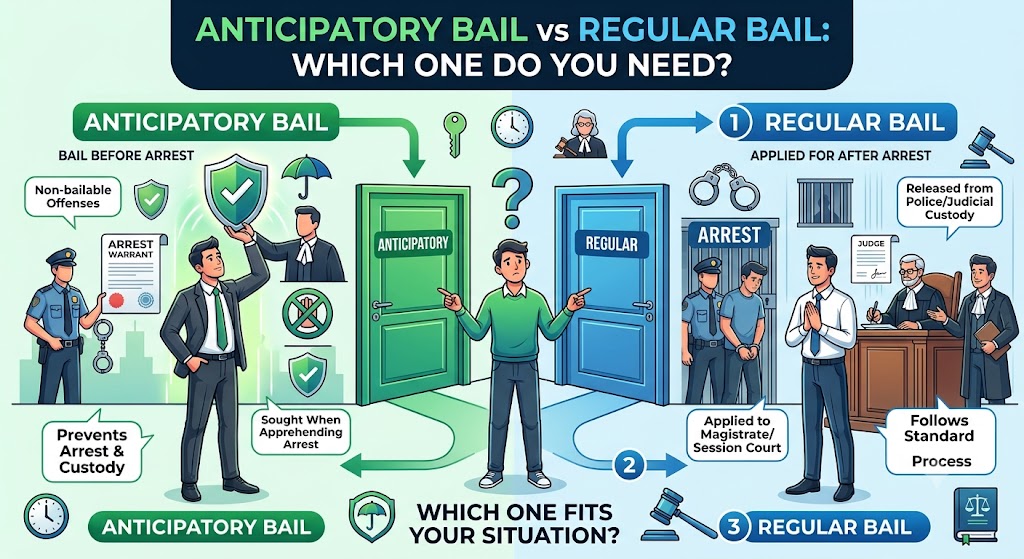
- Anticipatory bail is applied for before an arrest — when a person has reason to believe they may be arrested in connection with a non-bailable offence, typically after an FIR has been filed against them, or when they learn one is likely to be filed.
- Regular bail is applied for after an arrest has already taken place, when the person is in custody (police or judicial) and seeking release.
Everything else follows from this one difference.
Anticipatory Bail: Protecting Your Liberty Before Arrest
Anticipatory bail is filed under the provision that allows the High Court or Sessions Court to direct that, in the event of arrest, the person shall be released on bail. It does not prevent an FIR from being registered — it prevents the arrest itself from resulting in custody.
When it’s typically used:
- An FIR has been filed against you and you fear imminent arrest.
- You’ve learned of a police complaint and want to avoid the disruption and stigma of arrest while you contest the allegations.
- In business, matrimonial, or property disputes that have escalated into criminal complaints, often to pressure the other side.
Key point: Anticipatory bail must be sought before arrest. Once arrested, this option is no longer available — the case shifts entirely to regular bail instead. This is why timing matters so much, and why waiting to “see what happens” after learning of an FIR can close off your best option.
Where to File: Sessions Court or High Court?
Anticipatory bail applications can be filed in either the Sessions Court or the High Court — both have concurrent jurisdiction to hear them. While many applicants approach the Sessions Court first as a matter of practice, there is no legal requirement to do so, and directly approaching the High Court is a valid and often advisable route, particularly in complex, high-stakes, or urgent matters where a swift, well-argued hearing matters most. We can advise on the appropriate forum to approach based on the specific facts of your case.
Regular Bail: Securing Release After Arrest
Regular bail is what’s sought once a person is already in police or judicial custody. It can be applied for at different stages — right after arrest, during police remand, or later during trial — and the court’s approach depends heavily on the nature of the offence.
When it’s typically used:
- After an arrest has taken place and the person is in custody.
- When police custody (remand) has ended and the person has been sent to judicial custody.
- At later stages of a case, if bail wasn’t granted initially or circumstances have changed.
Bailable vs Non-Bailable Offences — Why This Matters
Whether you even need to formally argue for bail — or it’s granted as a matter of right — depends on how the offence is classified:
- Bailable offences: Bail is generally a matter of right, and can often be granted by the police station itself or the court without much contest.
- Non-bailable offences: Bail is at the discretion of the court, and this is where the strength of legal representation, the facts of the FIR, and the arguments presented make a real difference to the outcome.
Most situations where anticipatory bail becomes necessary involve non-bailable offences, since that’s where the risk of arrest and custody is real.
Which One Do You Need? A Simple Way to Think About It
- Not yet arrested, but worried you might be? → Anticipatory bail is your option, and time is critical — file as early as possible.
- Already arrested or in custody? → Regular bail is the only path forward from here.
- Unsure whether an FIR has even been filed against you? → This is worth checking immediately with a lawyer, since it directly determines which of the two applies.
A Word on Timing
Both types of bail are urgent matters by nature, but anticipatory bail carries an added layer of urgency: it is only available in the window before arrest. Once arrest happens, that door closes. If you have any indication that a complaint has been made against you — a phone call from police, a notice, or knowledge of an FIR — the safest step is to consult a lawyer immediately to assess whether an anticipatory bail application should be filed without delay.
Read more: [Arrested in Uttarakhand — What Happens in the First 24 Hours?] — and if you believe the underlying complaint against you is false or legally defective, see [Can an FIR Be Cancelled? Understanding Section 482 CrPC / Section 528 BNSS].
Disclaimer: This article is intended for general informational purposes only and does not constitute legal advice. The applicability of anticipatory or regular bail depends entirely on the specific facts of each case, the nature of the offence, and the jurisdiction involved. Reading this article does not create an advocate-client relationship with Khokher Advocates. If you or someone you know is facing arrest or is already in custody, please consult a qualified advocate without delay.